
Turn Doctor–Patient Conversations Into a Managed Performance Metric
Practice on a realistic AI patient, get scored on soft and hard skills, and see the whole team’s readiness.
Strong in Diagnosis, Weaker in Dialogue
Private-clinic doctors usually know medicine inside out. But a patient comes back, or leaves, not because of the diagnosis, but because of how they were spoken to.
Hard Skills — On Point
Knowledge, protocols, diagnostics
Soft Skills — The Blind Spot
Empathy, explanation, trust, difficult conversations
How long a doctor listens on average before interrupting the patient
Only 36% of doctors let the patient state the reason for the visit.
Source: Singh Ospina N et al., J Gen Intern Med. 2018. 112 recorded consultations.

A Weak Conversation Costs the Clinic Patients, Trust and Money

Sources: CRICO Strategies, 2015; Becker C et al. JAMA Netw Open. 2021; Press Ganey, Healthcare Consumer Experience 2025.
Empathy Fades With Practice
Studies record a decline in empathy through training and residency, sharpest in the third year. It must be trained deliberately, because it doesn’t grow on its own.
Sources: Hojat M et al. Acad Med. 2009; Neumann M et al. Acad Med. 2011.
Schematic, based on longitudinal data using the Jefferson Scale of Empathy
Practice the Conversation, Then Measure It
Patients Who Push Back. Hesitation, fear, argument, silence. On video, where presence and gesture matter, or by voice alone
Your scenarios, your specialty. Built around the cases your doctors run into every week
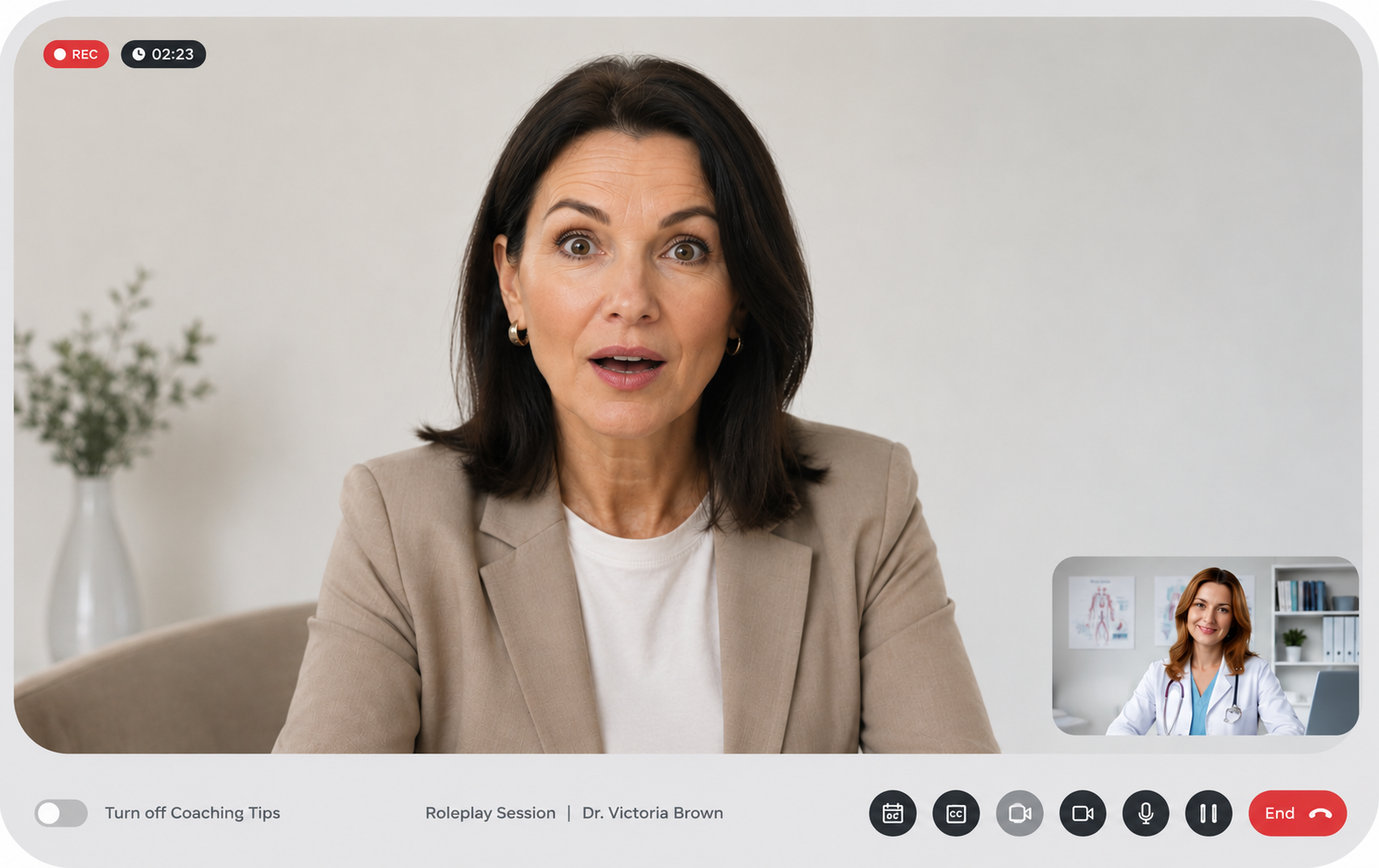
Coaching inside the session. Guidance in the moment, not a report to review later
Soft and hard skills in one score. A wrong fact delivered warmly still fails. Both are scored together
Conversations That Are Hard to Rehearse in Real Life
A Difficult Diagnosis
Deliver bad news calmly and humanely
Refusing Treatment
Motivate without pressure or fear
Sensitive Topics
Intimate matters, lifestyle, mental health
A Confrontational Patient
Defuse tension and steer the conversation back
A Complex Treatment Plan
Explain it so the patient understands and follows through
Explaining the Price
Justify the cost so it reads as value, not as a number
The First Enquiry
Build trust remotely, before the patient has met anyone
Setting Expectations Before Travel
Timelines, what is included, what happens after landing
Your Scenario
Tailored to your clinic’s specialty
Specific Moments You Can Fix Right Away
Not “try to be more attentive,” but a precise prompt on a specific line of the conversation.
Coach’s prompt: You moved to the plan before the patient absorbed the word. Nothing after “malignancy” was heard. Say it, then stop and wait. Give the plan when the patient asks for it.
From a Scenario to Measurable Progress
Turn your own cases and patient profiles into simulations that match your specialty
Your doctors practice the conversations in a space where mistakes cost nothing
Every session is scored on soft and hard skills, and you can see the exact words behind it
Each doctor gets a path built on their own data, with the next scenario aimed at what is still weak
Leadership sees how every clinician is moving, and where the whole team stands today
Visibility for Leadership
Team Skill Map
Expected Results
What the Rest of the Field Does Not Have
Patients, Not Chatbots
They hesitate, resist, get confused, go silent, and react to the doctor's tone like real patients do. Sessions run on video, not only by voice
CoachLoop: Score,
Targeted Practice, Remeasurement
An AI coach explains what worked and what did not. Each session adds to one profile per clinician
Guardrails and Session Integrity
What the patient may say, what the model may score, what it must refuse, and the checks that make a score earned
Built for Regulated Markets
GDPR-structured, HIPAA-capable, ISO 27001 and SOC 2 in progress. Under the AI Act: observable behavior only, never inferred emotion
What Clinics Ask Us First
What is Rolevance.MD?
Rolevance.MD is an AI roleplay and coaching platform for clinical communication. A doctor holds a consultation with a realistic AI patient, the model scores the conversation on soft and hard skills, and the next session is aimed at whatever is still weak.
Who is Rolevance.MD for?
Rolevance.MD is built for clinics, networks and hospitals: medical directors, heads of department and training leads who are accountable for patient experience, repeat visits and complaints. Individual physicians use it to rehearse conversations before they happen.
What does Rolevance.MD measure?
Rolevance.MD measures empathy, clarity of explanation, active listening and the structure of the consultation, alongside the clinical accuracy of what was said. Leadership sees the same measures per clinician and per team, tracked across repeated sessions.
How does Rolevance.MD score a conversation, and is the score a black box?
Rolevance.MD scores each behavior against constructs derived from validated consultation-rating instruments, not against keyword matching. Every score points back to the words in the conversation that produced it, so a manager can see exactly why a session scored the way it did.
Which conversations can doctors practice on Rolevance.MD?
Delivering a difficult diagnosis, a patient refusing treatment, sensitive topics, a confrontational patient, a complex treatment plan, explaining the price, the first inquiry and setting expectations before medical travel. Clinics can also author scenarios for their own specialty.
How are Rolevance.MD scenarios created, and can a clinic build its own?
Every Rolevance.MD account starts with the core clinical library. A clinic can add its own scenarios, authored with its medical team from the cases and patient profiles it already knows.
How is Rolevance.MD different from ChatGPT or a generic AI roleplay tool?
A general model will hold the conversation, but it will not judge it. Most roleplay platforms come from sales training and score the delivery rather than the content, while Rolevance.MD scores clinical accuracy alongside communication, keeps a record of what improved between sessions, gives the person responsible for the team a view of it, and applies guardrails that stop the simulated patient from behaving in ways a real patient never would.
Do doctors need to install anything to use Rolevance.MD?
No. Rolevance.MD runs in a web browser, with nothing to install and no IT setup. A doctor needs a quiet place to talk and a gap between appointments.
Does Rolevance.MD provide medical advice?
No. Rolevance.MD is a coaching instrument for clinicians and does not provide medical, clinical or regulatory advice. AI-generated feedback may be inaccurate or incomplete and is not a substitute for professional judgment.
Can Rolevance.MD scores be used for employment decisions?
No. The Rolevance.MD score is a coaching instrument. It shows where a clinician is strong and where practice is needed.
Does the Rolevance.MD score predict patient experience results?
That is the primary question our clinical pilots answer. Whether a better score moves NPS, complaints or repeat visits in a specific clinic is measured with that clinic, not promised in advance.
How do we get started with Rolevance.MD?
Book a demo and we will walk through the platform with your own scenarios and specialty, then agree the scope of a first pilot with one team.